
If you’re trying to grow your business online, you’ve probably heard people recommend both websites and sales funnels. While they may seem similar, they are built for different purposes.
Understanding the difference between a sales funnel and a website can help you generate more leads, improve your conversion rate, and maximize your marketing budget.
In this guide, we’ll explain how each one works, their advantages, and when you should use one—or both—to grow your business.
What Is a Website?
A website is your business’s online headquarters. It contains multiple pages that allow visitors to learn about your company, explore your services, read blog posts, view your portfolio, and contact you.
A professional business website usually includes:
- Home Page
- About Page
- Services
- Portfolio
- Blog
- Contact Page
- FAQ
A website is designed for exploration. Visitors can navigate freely to any page they choose.
Benefits of a Website
- Builds trust and credibility
- Improves Google search visibility
- Displays your complete services
- Supports blogging for SEO
- Works as your long-term online presence
However, because visitors have many navigation options, they can also leave without taking any action.
What Is a Sales Funnel?
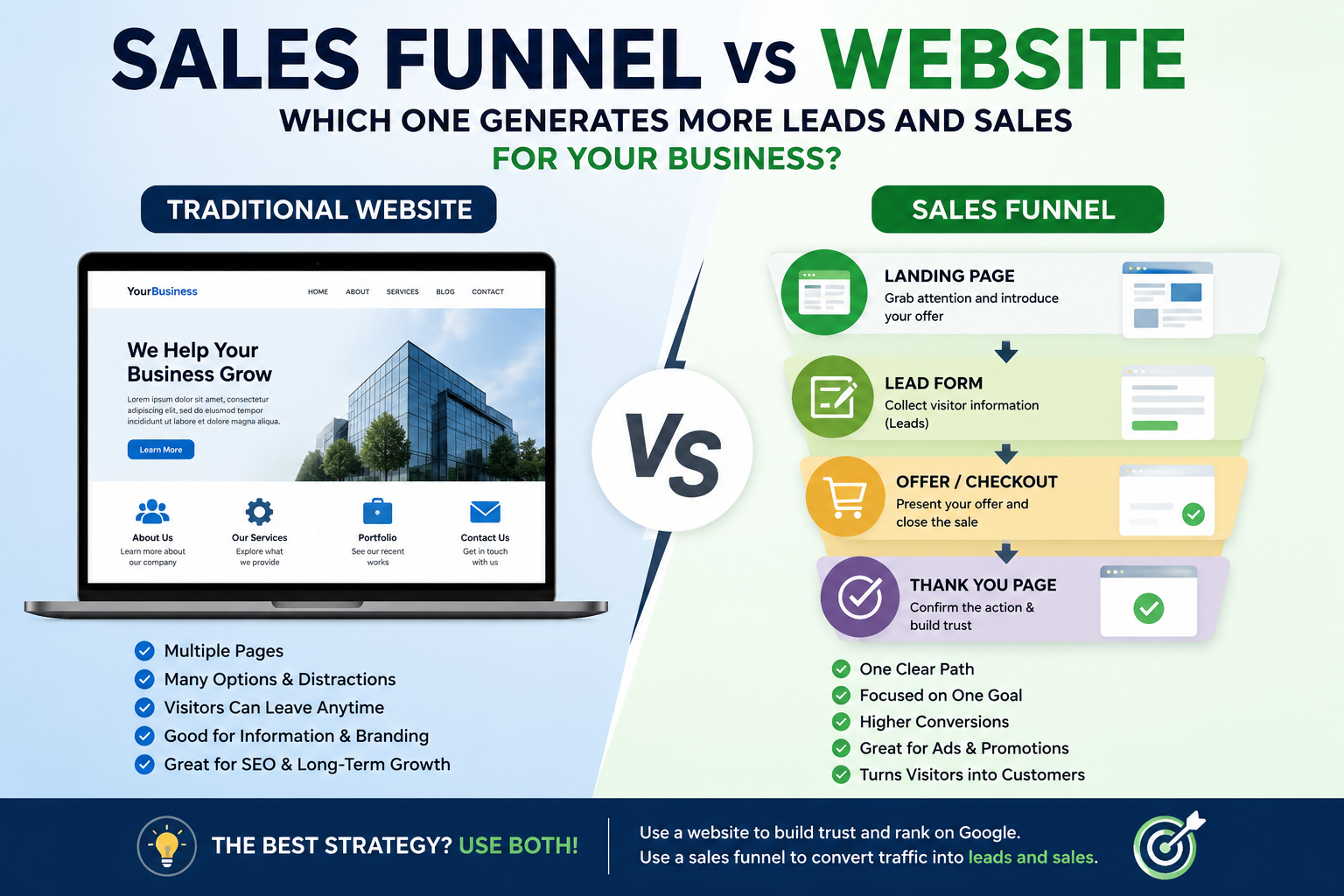
A sales funnel is a carefully designed sequence of pages that guides visitors toward one specific action.
Instead of giving users multiple choices, a funnel focuses on a single goal.
For example:
Facebook Ad → Landing Page → Booking Form → Thank You Page
or
Google Ad → Offer Page → Checkout → Upsell → Confirmation
Every page removes distractions and encourages visitors to complete the next step.
Sales Funnel vs Website: What’s the Difference?
| Website | Sales Funnel |
|---|---|
| Multiple pages | Focused flow |
| Many navigation options | One clear path |
| Great for SEO | Great for paid advertising |
| Builds brand credibility | Maximizes conversions |
| Visitors browse freely | Visitors are guided to act |
Think of it this way:
A website is like a shopping mall where customers can explore many stores.
A sales funnel is like a guided checkout line that leads customers directly to a purchase or booking.
Which One Converts Better?
If your goal is to generate leads or sales from paid advertising, a sales funnel almost always outperforms a traditional website.
Why?
Because funnels eliminate distractions.
Instead of asking visitors to choose between ten menu items, a funnel asks them to complete one action, such as:
- Book a consultation
- Request a quote
- Buy a product
- Download a guide
- Schedule a demo
This focused experience often results in significantly higher conversion rates than sending ad traffic to a general homepage.
When Should You Use a Website?
A website is the right choice if you want to:
- Build long-term brand authority
- Rank on Google with blog content
- Showcase your services
- Display your portfolio
- Publish company updates
- Help customers learn more about your business
Every serious business should have a professional website.
When Should You Use a Sales Funnel?
A sales funnel is ideal when you’re:
- Running Facebook Ads
- Running Google Ads
- Promoting a limited-time offer
- Launching a new service
- Collecting leads
- Selling digital products
- Booking appointments
Funnels are designed to convert traffic into customers efficiently.
Why Successful Businesses Use Both
The most successful businesses don’t choose between a website and a sales funnel—they use both strategically.
Your website serves as your brand’s information hub, while your sales funnels are used for marketing campaigns and lead generation.
For example:
- Someone discovers your business through Google and visits your website to learn more.
- Another person clicks a Facebook advertisement and lands directly on a sales funnel designed to encourage booking or purchasing.
This combination helps you build trust while maximizing conversions.
Common Mistakes Business Owners Make
Sending Paid Traffic to the Homepage
Homepages contain menus, links, and distractions that can reduce conversions.
Having No Clear Call to Action
Every page should tell visitors exactly what to do next.
Not Following Up With Leads
Capturing a lead is only the first step. Automated email and SMS follow-ups help convert more prospects into customers.
Ignoring Mobile Optimization
Most users browse on their phones. Ensure both your website and funnels load quickly and display correctly on mobile devices.
Frequently Asked Questions
Is a sales funnel better than a website?
A sales funnel is generally better for generating leads and sales from marketing campaigns because it guides visitors toward a single action. A website is better for building credibility, providing information, and improving long-term visibility in search engines.
Do I need both a website and a sales funnel?
Yes. A website helps establish your brand and attract organic traffic, while sales funnels are optimized to convert visitors from ads, email campaigns, and promotions into customers.
Can a sales funnel replace a website?
Not completely. A sales funnel focuses on a specific conversion goal, whereas a website serves as your business’s central online presence with broader information about your company and services.
Which is better for SEO?
A website is generally better for SEO because it supports multiple pages, blog content, and internal linking, all of which help improve search engine visibility over time.
Final Thoughts
Choosing between a sales funnel and a website isn’t about deciding which is universally better—it’s about selecting the right tool for the right objective.
If your goal is to build brand trust, showcase your services, and attract organic traffic through search engines, a website is essential.
If your goal is to maximize leads, appointments, or sales from advertising and promotional campaigns, a sales funnel is the more effective option.
Businesses that combine a professional website with strategically designed sales funnels are often in the strongest position to grow online because they benefit from both long-term visibility and high-converting marketing campaigns.
If you’re looking to build a modern website, create high-converting sales funnels, or migrate your existing online presence to GoHighLevel, Otilek Digitals can help you develop a solution tailored to your business goals.